This photograph has not been altered. Investigate, and make an effort not to pant…
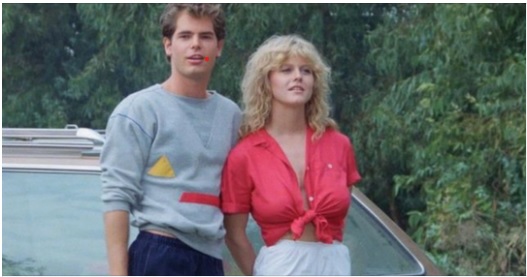
However not very notable, the 1985 film “Malicious Town” includes a couple of important scenes. This photo, which highlights Lynda Wiesmeier, catches one of these times. From the start, it seems to be a common 1980s photograph. Remaining before a vehicle are a young fellow and lady wearing regular 80s clothing. Yet, in the event that you look at all the more intently, you could find something unforeseen.
The man wears dim shorts and a dim hoodie enhanced with diverse themes. The lady embellishes high-waisted white shorts and a radiant red top, hitched at the midsection. Their incredibly classic clothing is an ideal fit for the period’s design. VIEW THE Photograph Under
However, the scene really draws consideration. An older, earthy colored station vehicle remains before them. Tall trees cover the foundation, loaning the picture a peaceful, natural quality. The vehicle, the trees, and the garments all transport you to the 1980s.
The picture might bring back recollections of more straightforward times, or it might simply seem to be a charming legacy. Regardless, an intriguing section of realistic history exhibits how much has changed. So investigate, relish the sentimentality, and perhaps heave at how different everything appears to be contrasted with now.
At first glance, it looks like an ordinary image — the kind you might scroll past without a second thought. But people who pause long enough to truly examine it often report the same unexpected reaction: a sudden rush of adrenaline, a tightening in the chest, and the unmistakable urge to catch their breath.
The photograph, which has circulated widely online, comes with a simple but provocative claim: it has not been edited, enhanced, or manipulated in any way. No filters. No digital tricks. What you see is exactly what was captured in that single moment.
So why does it feel so intense?
The Power of Perspective
Our brains rely heavily on context to interpret what we’re seeing. When an image disrupts that context — especially through unusual angles, depth perception, or scale — the brain scrambles to make sense of it. That confusion can trigger a physiological response similar to fear or excitement.
In this case, the photo appears to show a precarious situation involving height, balance, or spatial distortion. But the truth behind it is often far less dangerous than it seems. Clever positioning, forced perspective, and timing can create scenes that look almost impossible, even when they’re completely safe.
It’s a reminder that perception isn’t always reality.
Why Your Body Reacts
When you encounter an image that suggests danger — such as someone standing near an apparent drop or performing a risky act — your nervous system can react automatically. Even though you’re perfectly safe, your brain processes the visual cues as if they were real.
That’s why some viewers instinctively hold their breath or feel their heart rate increase. It’s the same mechanism that makes suspenseful movie scenes feel intense, except this time your brain believes it might be real.
The Fascination With “Unedited” Moments
In an era dominated by digital manipulation, people are naturally drawn to images that claim authenticity. The idea that something astonishing happened exactly as shown — without editing — adds to the intrigue.
It also sparks curiosity. Viewers start investigating details: shadows, reflections, proportions, background clues. The more they analyze, the more captivating the image becomes.
A Lesson in Looking Twice
Whether the photo leaves you amazed, uneasy, or simply curious, it highlights something important: our eyes can be fooled, but that doesn’t make the experience any less real.
Sometimes the most powerful images aren’t the ones created with software — they’re the ones captured at precisely the right moment, from precisely the right angle, letting reality do all the work.
And if you did find yourself holding your breath while looking at it… you’re definitely not alone.