DISGRACEFUL: Democrat Caught Sharing Guillotine With Trump’s Head — Now Her Career May Be Over
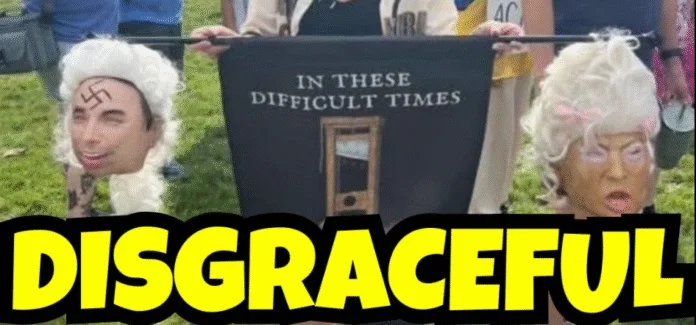
North Carolina Representative Julie von Haefen (D) is facing explosive backlash after posting a video from a Raleigh “No Kings” protest — including a shocking sign of a guillotine with a head resembling President Donald Trump. The scandal has set off a political firestorm.
Almost immediately, von Haefen deactivated her social media accounts and issued an apology, admitting she had edited the video to remove the disturbing im age. She insisted: “I condemn political violence in all forms.”
But leaders across the state aren’t buying it. N.C. GOP Chairman Jason Simmons declared: “Her posts do not show the judgment or temperament of someone fit for public office. She should resign.”
House Speaker Destin Hall went further, condemning her “disgraceful behavior” and noting the chilling timing: “On the same weekend a gunman targeted lawmakers in Minnesota, she glorified violence against political opponents — including the President.”
Even Apex Mayor Jacques Gilbert rebuked the imagery, saying it “crosses a moral line” and promotes division.
Meanwhile, conservative influencers are calling for her removal. One viral post read: “Julie von Haefen should be nowhere near state power. She pushed tampon bills, union garbage — and now violent fantasies of Trump’s beheading. Remove her.”
The fallout is growing by the hour. Will von Haefen be forced to step down — or will Democrats protect her? One thing is certain: the outrage isn’t going away anytime soon.
A Democratic figure is facing intense backlash after reportedly sharing an image online that appeared to depict a guillotine alongside the head of former President Donald Trump. The post, which quickly circulated across social media platforms, sparked widespread condemnation from political leaders, commentators, and members of the public, with many calling the imagery deeply inappropriate and inflammatory.
Critics from across the political spectrum argued that the image crossed a clear line, escalating political rhetoric into disturbing symbolism. While political satire and sharp criticism are common in modern discourse, many observers noted that references to execution imagery undermine civil debate and contribute to a toxic political environment.
Following the backlash, the individual at the center of the controversy reportedly removed the post. However, screenshots had already spread widely, prompting renewed scrutiny of public figures’ conduct online. Calls for accountability intensified, with some demanding formal consequences and others questioning whether such actions are compatible with holding public or party-affiliated roles.
Several lawmakers and political analysts emphasized that leaders bear a responsibility to de-escalate tensions rather than inflame them. In an era marked by polarization and heightened emotions, they warned that violent symbolism—regardless of intent—can have serious real-world consequences.
Supporters of free expression cautioned against overreaction, arguing that context and intent should be carefully examined. Still, even some within the same political party expressed discomfort, stating that the image reflected poorly on the broader movement and distracted from substantive policy discussions.
As the controversy continues to unfold, questions remain about potential disciplinary action and the long-term impact on the individual’s career. The incident has reignited a broader debate about the boundaries of political expression, the responsibilities of public figures on social media, and how far is too far in partisan conflict.
Whether this moment becomes a turning point or fades amid the fast-moving news cycle, it has once again highlighted the fragile state of political discourse and the consequences that can follow a single online post.